

How to Play Falling Pickaxe: A Round, Step by Step
In short: A round of Falling Pickaxe starts with one reel that lands on a Cross or on one of four pickaxes. The pickaxe falls through blocks until its durability runs out, and everything it broke pays at once.
You make exactly one decision in this game, and it is your stake. Everything after that is the reel, the tool it hands you and the depth your durability buys.
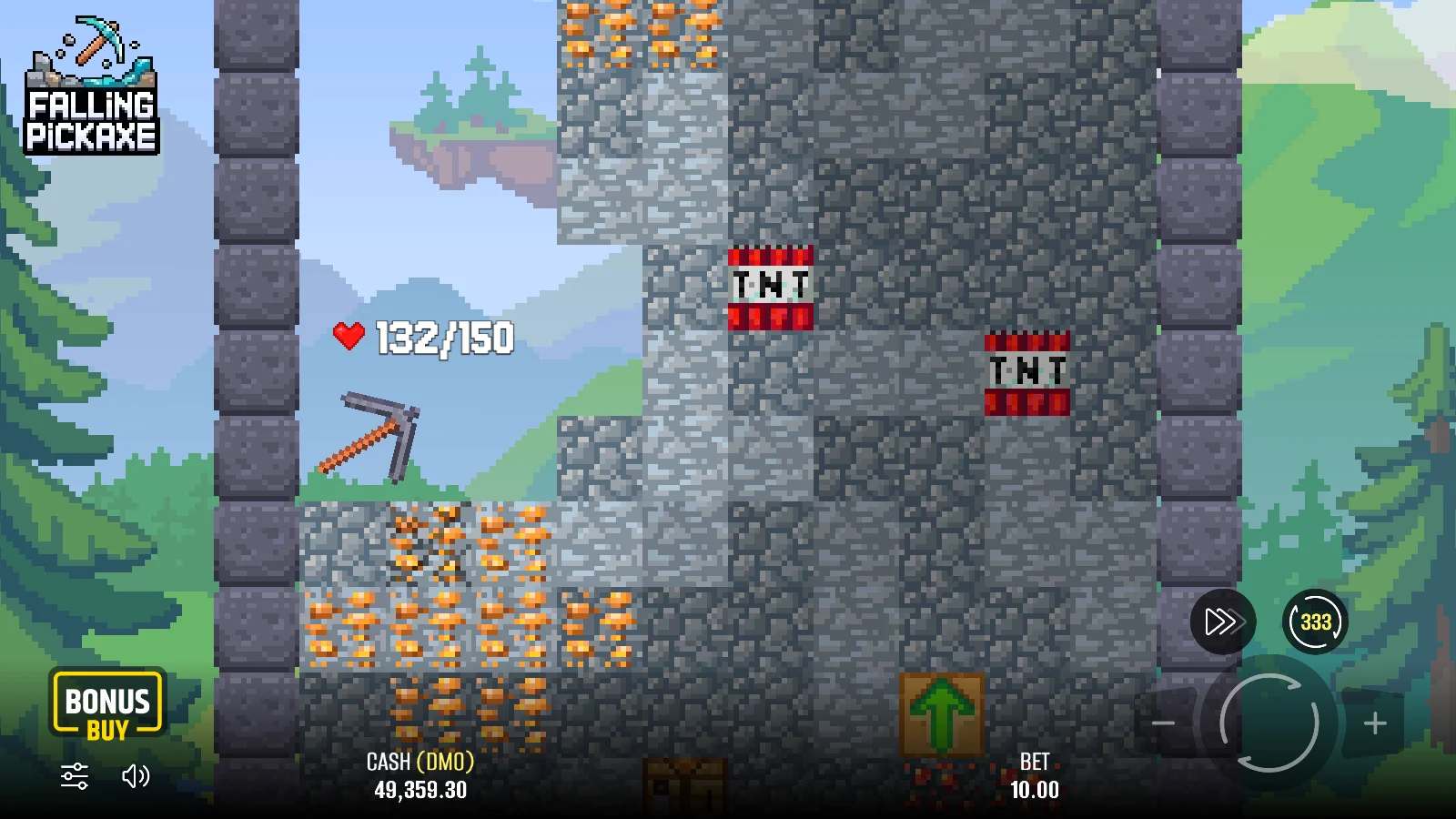
- Game:
- Falling Pickaxe (a Pixmove instant-win game)
- Type:
- Instant game
- RTP as published:
- 95%, printed on the maker's own game page, in its catalogue data and in its press release, and printed on no screen inside the game itself.
- Max win:
- 160 times the bet, which is what the maker's own game page and its catalogue data both print.
Note: There is no skill input in this game at all once you have set a stake, so the useful thing to learn is what each outcome is worth. One reel decides whether you get a tool at all, the tool's durability decides how far you travel, and the blocks on the way down decide what you are paid.
Everything below comes off the rules screen inside the client, which we read end to end on , plus the 259 rounds we logged from the game server's replies.
Table of contents
What You Need Before You Start
Before you start, check these prerequisites; each one takes a minute and saves a wasted round.
- A browser. The game runs in one, with no download and no app.
- A stake you have decided on before you start, because the panel offers steps from 10.00 to 20,000.00.
- Nothing else. The maker's demo needs no account, no deposit and no age confirmation.
How a Round Plays, Step by Step
Follow these steps in order; the index below jumps to any step, and each step names the control it uses.
- Step 1: Set your stake first
- Step 2: Press the round button and watch one reel
- Step 3: Read the durability number, not the picture
- Step 4: Let the pickaxe fall and count the ore, not the rubble
- Step 5: Watch for the three blocks that change the round
- Step 6: Wait for the counter to reach zero
- Step 7: Decide about the bonus buy separately
Step 1: Set Your Stake First
Use the plus and minus keys, or open the bonus-buy screen where the slider prints Min 10 and Max 20000. The default is 30.00.
Step 2: Press the Round Button and Watch One Reel
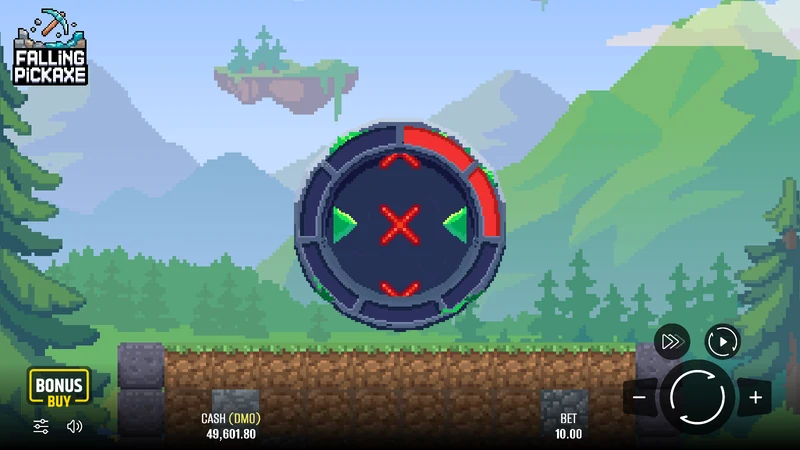
It stops on a Cross, which gives you nothing, or on a Wooden, Stone, Iron or Diamond pickaxe.
Step 3: Read the Durability Number, Not the Picture
Wooden carries 100 points, Stone 150, Iron 200 and Diamond 400. That number is how many hits your round is worth.
Step 4: Let the Pickaxe Fall and Count the Ore, Not the Rubble
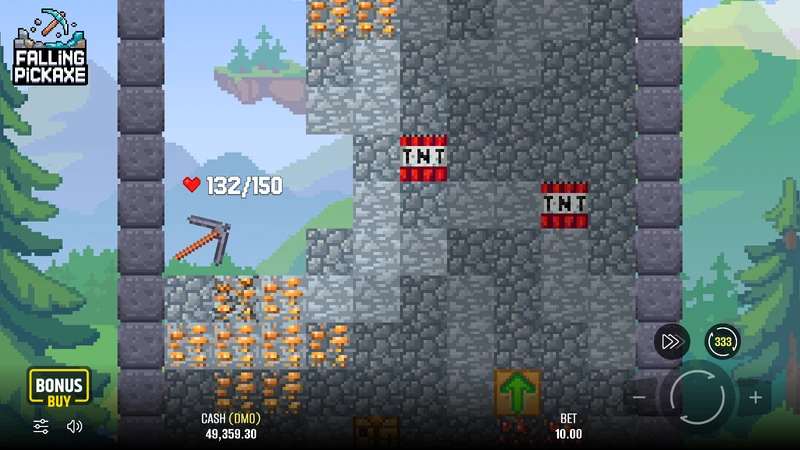
Dirt and stone cost a hit and pay nothing. Copper pays x0.01 of the bet, Redstone x0.05, Gold x0.2, Diamond x1 and Emerald x5.
Step 5: Watch for the Three Blocks That Change the Round
TNT clears a radius, the Upgrade Arrow widens your pickaxe to 1.5 times for three seconds, and the Workbench repairs it fully and lifts it one tier.
Step 6: Wait for the Counter to Reach Zero
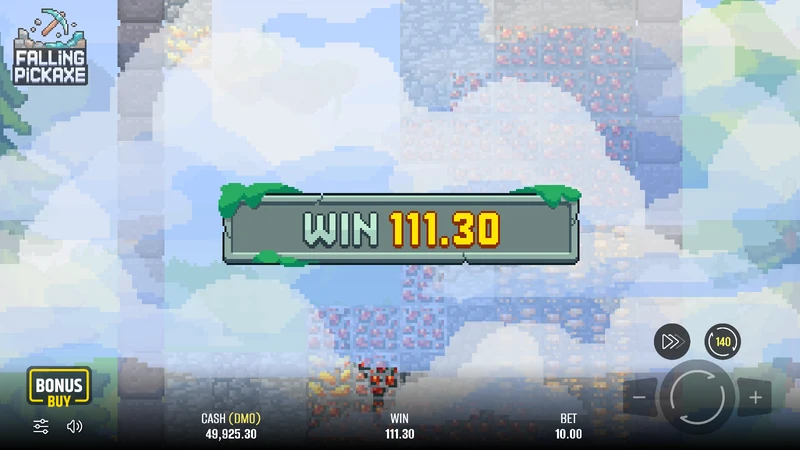
The round ends there, and every payout collected on the way down is added up and handed over in one plate.
Step 7: Decide About the Bonus Buy Separately
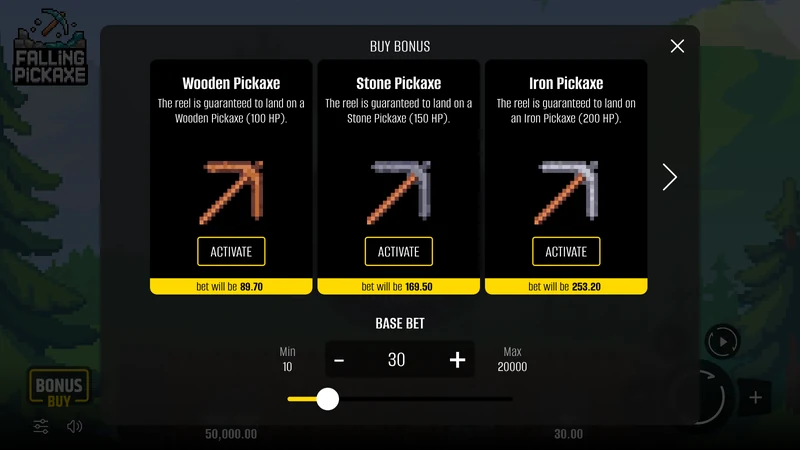
Four doors guarantee a pickaxe tier instead of leaving it to the reel, at 89.70, 169.50, 253.20 and 315.00 when your base stake is 30.00.
Before You Play: What the Reel Decides
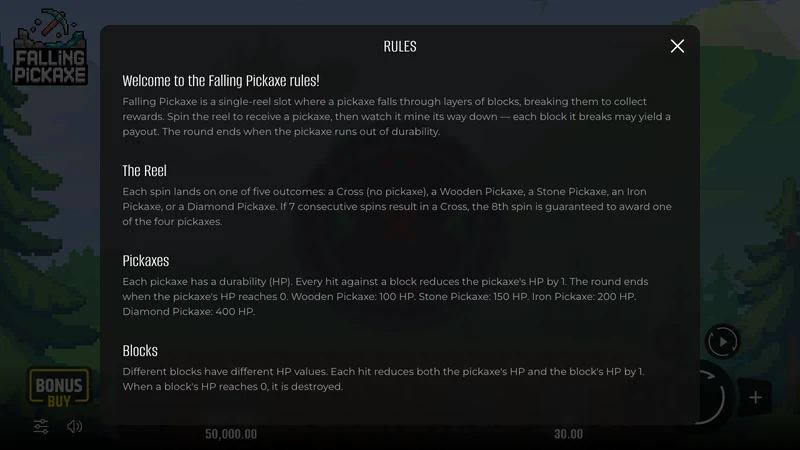
The reel decides everything, and it does it with five outcomes, one of which is nothing. The rules screen names them in order: a Cross, a Wooden Pickaxe, a Stone Pickaxe, an Iron Pickaxe and a Diamond Pickaxe.
| Outcome of the reel | Durability it hands you | What that buys in hits |
|---|---|---|
| Cross | None | The round ends before it starts |
| Wooden pickaxe | 100 HP | 100 hits against blocks |
| Stone pickaxe | 150 HP | 150 hits |
| Iron pickaxe | 200 HP | 200 hits |
| Diamond pickaxe | 400 HP | 400 hits |
Read on ; the maker can change a screen without saying so.
A Cross ends the round where it began. You paid the stake, the reel handed you no tool, and nothing falls. In our session those empty rounds were common enough to matter, which is what the eighth-round rule exists to soften.
The Eighth Round Rule
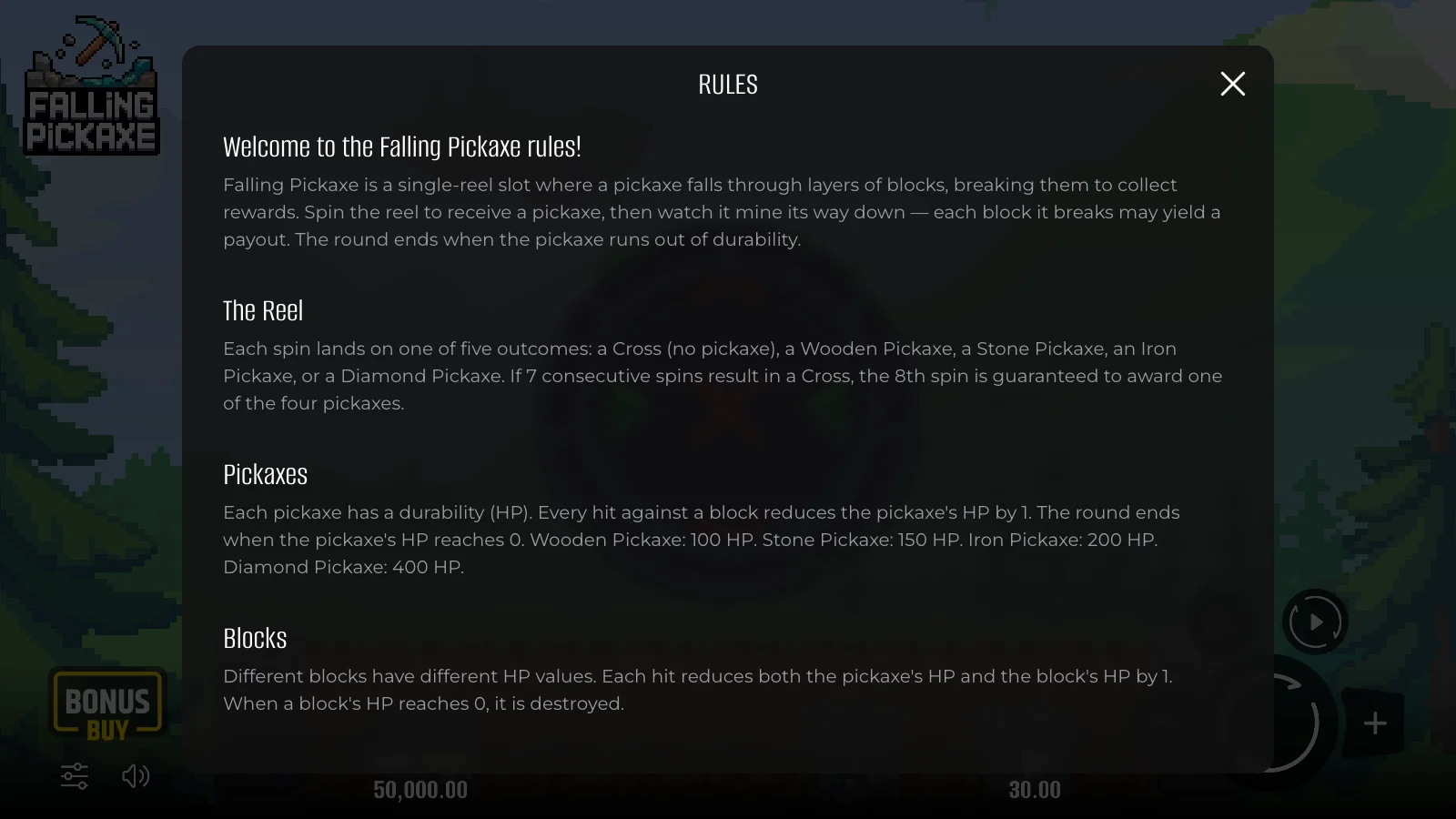
The eighth round rule is printed in the game itself, in one sentence: "If 7 consecutive spins result in a Cross, the 8th spin is guaranteed to award one of the four pickaxes." The server enforces something close to it, and our own rounds show the difference.
The counter behind it is slightly different from the sentence. We logged it across 259 rounds. It rose after every round that paid nothing, including rounds where a pickaxe had been dealt, so what it counts is payouts rather than crosses. It reached seven twelve times, and on all twelve the next round paid rather than merely handing over a tool. We never saw the counter reach eight, so the printed rule, in its own words, never had to fire.
One line of that promise is never printed. The server keeps one counter per stake step, and ours stayed at zero on the other fourteen all session long.
Reading the Block Table
Read the block table as a price list: durability is a budget, and blocks have prices. Dirt and stone cost one hit each and pay nothing at all, which is most of what a shallow round meets. Ore costs more and pays: Copper takes 5 hits for x0.01 of the bet, Redstone 10 hits for x0.05, Gold 15 for x0.2, Diamond 20 for x1 and Emerald 30 for x5.
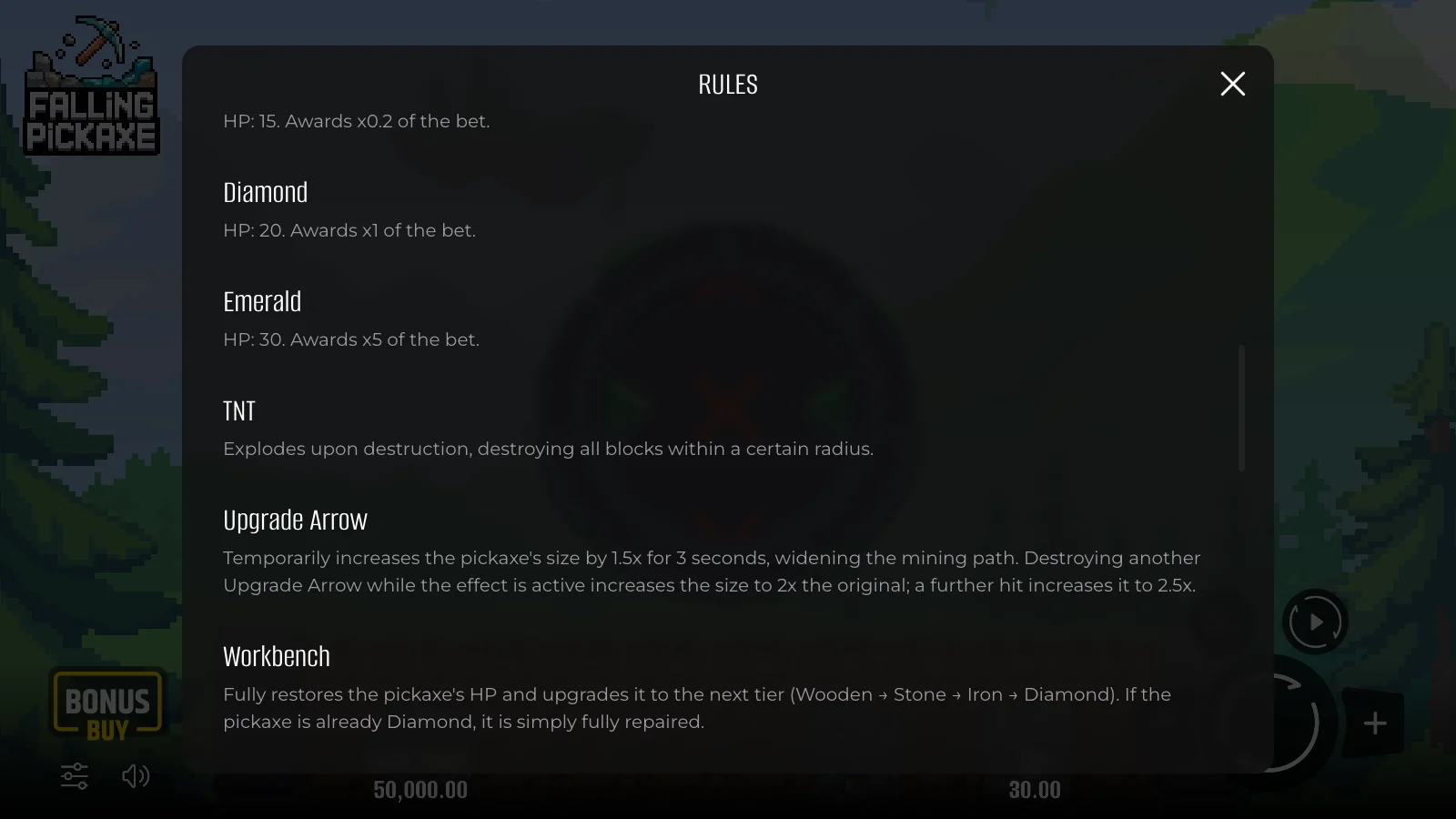
| Block | Hits to break it | What it pays |
|---|---|---|
| Dirt | 1 | Nothing |
| Stone | 1 | Nothing |
| Copper | 5 | x0.01 of the bet |
| Redstone | 10 | x0.05 |
| Gold | 15 | x0.2 |
| Diamond | 20 | x1 |
| Emerald | 30 | x5, the richest single block |
| TNT | On destruction | Clears a radius instead of paying |
| Upgrade Arrow | On contact | Widens the pickaxe to 1.5x, then 2x, then 2.5x |
| Workbench | On contact | Full repair and one tier up |
Notice the trade in those numbers. Emerald is worth 500 times what Copper is worth, and it costs six times as many hits to break. A round that meets one emerald seam late, with a repaired diamond pickaxe, is worth more than a round that grinds through copper from the top.
How to Play a Bought Round
You play a bought round exactly as you play any other. The bonus-buy screen removes the reel from the decision by guaranteeing a tier, and it prices that guarantee against your base stake. At 30.00 the four doors read 89.70, 169.50, 253.20 and 315.00.
Play one the same way you play any other round, because nothing else changes. The blocks are still dealt by the server, the ore is still where it falls, and the only thing you bought was the number on the durability counter.
When a Round Ends
A round ends the moment durability reaches zero, and not before. There is no cash-out, no stop button and no decision to make part way down, which is worth knowing if you have come from a crash game where timing is the whole skill.
Everything the pickaxe broke is added together at that moment and shown on one plate. The largest plate we photographed read 111.30 from a 10.00 stake, which is 11.13 times it; the best round of the whole logged session paid 43.16 times the stake.
What Playing Differently Cannot Change
Playing differently cannot change what any single round pays, and nothing in the game offers a skill input once the stake is set. No time of day and no sequence of buys moves the chance of an outcome.
One thing is genuinely in your hands, and it is not luck. The server counts rounds that paid nothing separately for each of the fifteen stake steps, so staying on one step keeps the progress you have already built toward the eighth-round rule, and moving the stake abandons it. That is the whole of what a stake pattern can do here.
Tip: Keep your stake on one step if you care about the eighth-round rule. The game server tracks the streak one counter per step, all fifteen of them, so moving the stake abandons the progress you built.
Treat the Workbench as the best block in the shaft. It is the only block that turns a 100-point wooden tool into a 400-point diamond one mid-fall, and depth is where the ore gets dense.
Expect most rounds to pay nothing. In our 259 logged rounds, 76.1% paid zero, and 90.3% came back worth less than the stake.
Key Terms Used on This Page
- Cross
- The reel outcome that awards no pickaxe, one of the five the rules screen names, and the one the eighth-round rule exists to limit.
- Workbench
- The block that fully repairs a pickaxe and raises it one tier, up to the 400-point Diamond.
- Upgrade Arrow
- The block that widens the pickaxe to 1.5 times its size for three seconds, then 2 times and 2.5 times on repeat hits.
Not sure yet? Learn the round with play money before any deposit.
Try the free demo first →This site takes no deposits and runs no identity checks; both stay off it entirely.
Related Reading on This Game
More on this game, from the same section first:
 Guides
Free Demo
50,000.00 in play money, no signup
 Guides
The Four Buys
Four buys from x2.99 to x10.50 stake
 Guides
The CNC Check
28 casinos and 3 bingos on the CNC list
 Reviews
500 Rounds Tested
92.0% returned over 500 demo rounds
 Reference
The 95% Figure
RTP 95%, printed nowhere in the game
 Reference
The Ceiling Dispute
x160 on the page, x165 in the release
What Else Do Readers Ask?
These are the questions a first round raises, answered from the rules screen and from the server replies we logged rather than from any listing.
How many outcomes does the reel have?
Five, and one of them is a Cross that hands you no pickaxe at all. The other four are the pickaxe tiers.
What is durability in Falling Pickaxe?
Durability is the hit budget of your pickaxe: 100 points on Wooden, 150 on Stone, 200 on Iron and 400 on Diamond.
Which block pays the most?
Emerald pays x5 of the bet and takes 30 hits to break, making it both the richest and the most expensive block on the screen.
Do dirt and stone pay anything?
No. Both cost your pickaxe a hit and award nothing, and the rules screen states that directly.
What does the Workbench do?
The Workbench fully repairs the pickaxe and lifts it one tier, from Wooden to Stone to Iron to Diamond, or repairs a Diamond outright.
Is there any skill in a round?
No. Once the stake is set, the reel and the fall are decided by the game server and nothing a player does changes them.
How do we test the rules?
We read the rules screen in full, then logged 259 rounds from the game server to check that the printed rules match what the server does.