

Falling Pickaxe Game Review: What 500 Rounds Showed
In short — our verdict: 5.2/10 — Falling Pickaxe is a Pixmove instant-win game that hands you a pickaxe, or nothing, and lets it fall through blocks. Pixmove publishes 95% RTP and two different ceilings for it, x160 and x165.
You can open this one for free in two clicks, and that turns out to be the easiest thing about it to check. The return, the ceiling and the volatility all live on a marketing page, and the one figure the game itself carries stops short of the screen.
5.2/ 10
- Published figures3.0
- Checkable inside the game1.5
- Licence and register7.0
- Cost of finding out8.5
- What a round pays6.0
Table of contents
- Falling Pickaxe Strengths and Weaknesses
- What 500 Rounds at the Smallest Stake Returned
- What a Falling Pickaxe Round Looks Like
- Where the Money Is in a Round
- Which Figures Pixmove Publishes
- The Eighth Round Rule
- The Licence Behind the Game
- Where the Falling Pickaxe Name Came From
- Who Should Skip This Game
- Which Surface Prints Which Figure
- Our Falling Pickaxe Verdict and Rating
- Key Terms Used on This Page
- What Else Do Readers Ask
Falling Pickaxe Strengths and Weaknesses
Pros: What Works Well
- Pro: The free demo opens in two clicks with 50,000.00 in play money, and asks for neither an account nor a deposit.
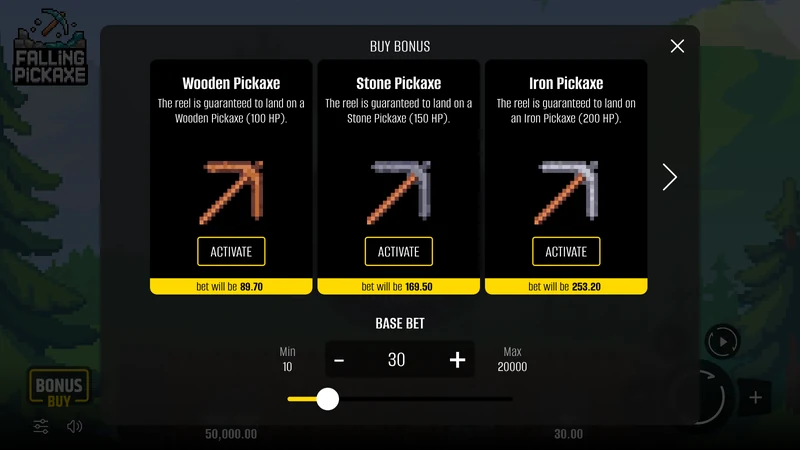
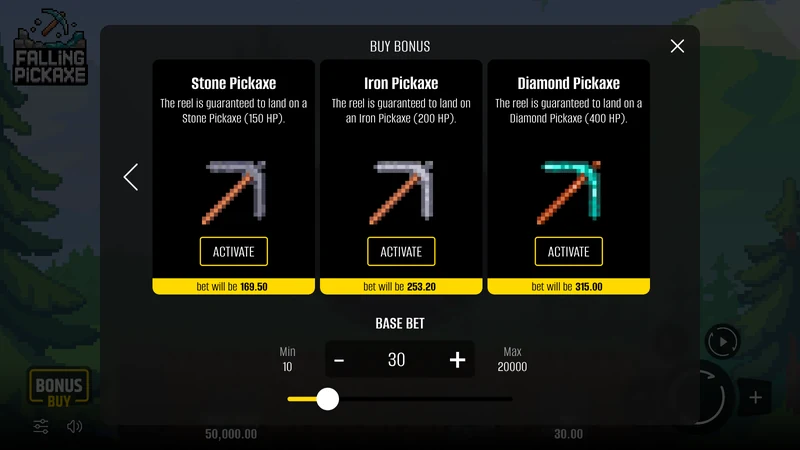
- Pro: The rules screen prints the durability of all four pickaxes and the payout of every ore block, so you can work out the shape of a round before you stake anything.
- Pro: The seal in the maker's footer leads to a working validator, and the regulator's public register carries that company under ALSI-202410066-FI2 against the same domain.
- Pro: After seven rounds without a payout, the eighth paid every single time in our run: 12 streaks, 12 payouts.
- Pro: The smallest stake is 10.00 in the units the game counts in, so finding all this out costs very little.
Cons: What Holds It Back
- Con: No screen inside the game states a return figure, a ceiling or any odds, and the one menu item is RULES. The server does send 95% for each bonus-buy door, and the client never shows it.
- Con: Pixmove contradicts itself on the ceiling: x160 on its game page and in its catalogue data, x165 in the press release it put out the same day.
- Con: 90.3% of our recorded rounds came back worth less than the stake, and the median paying round returned 0.52 times it.
- Con: The licence validator says in writing that the authority does not hear player disputes about payouts, bonuses or accounts.
- Con: Autoplay offers 1,000 rounds and an infinity button, and the panel leaves out a loss limit entirely.
What 500 Rounds at the Smallest Stake Returned
| Measurement | Figure | How we got it |
|---|---|---|
| Rounds played | 500 | Autoplay at a 10.00 stake, |
| Staked in total | 5,000.00 | 500 rounds at 10.00 each |
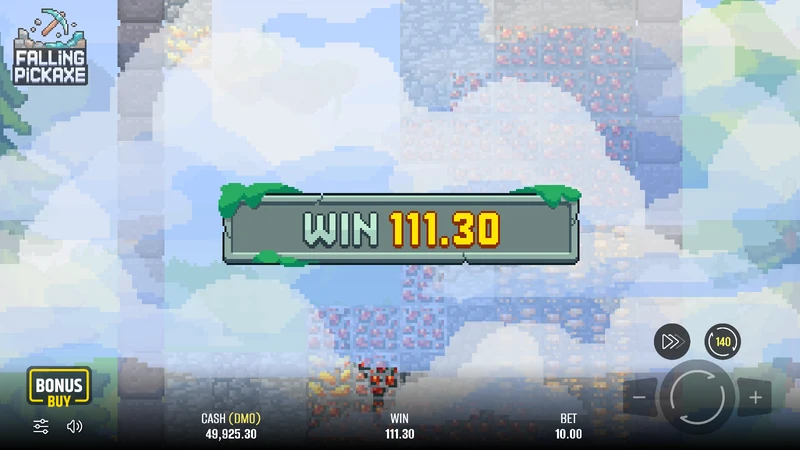
| Returned in total | 4,601.80 | Balance moved from 50,000.00 to 49,601.80 |
| Return over the session | 92.0% | Returned divided by staked, not a test of the published 95% |
| Rounds logged in detail | 259 | Read from the game server's own replies |
| Rounds that paid anything | 23.9% | 62 of the 259 |
| Rounds worth less than the stake | 90.3% | 234 of the 259 |
| Median paying round | 0.52x the stake | Middle value of the 62 paying rounds |
| Best round of the run | 43.16x the stake | Against a published ceiling of 160 |
Read on ; the maker can change a screen without saying so.
What a Falling Pickaxe Round Looks Like
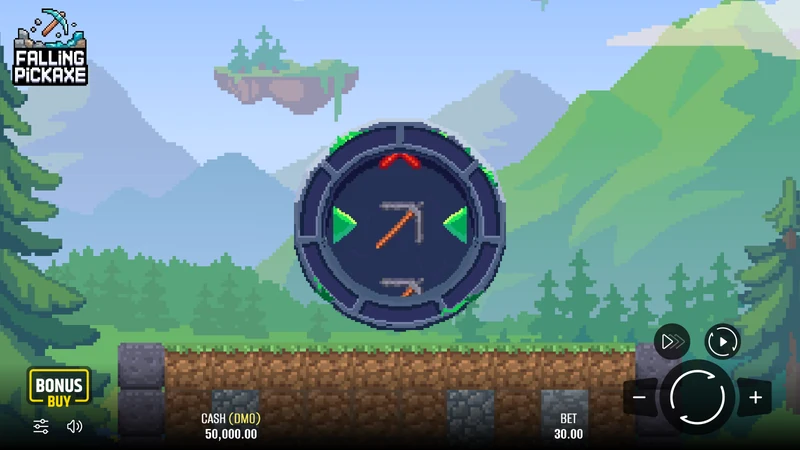
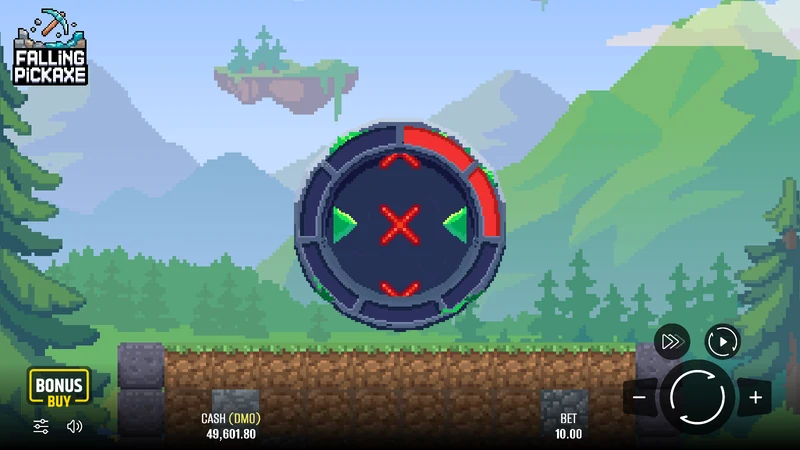
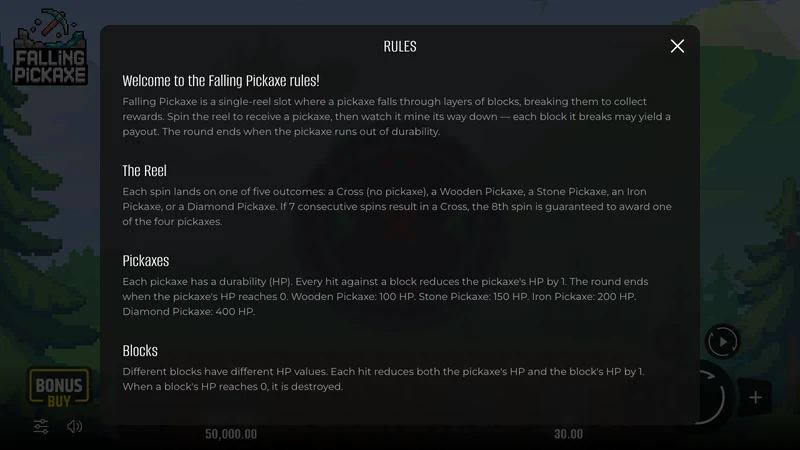
One reel, five outcomes, and the reel is the whole decision. It stops on a Cross, which gives you nothing, or on a Wooden, Stone, Iron or Diamond pickaxe. The pickaxe you get then falls, and it keeps breaking blocks until its durability runs out.
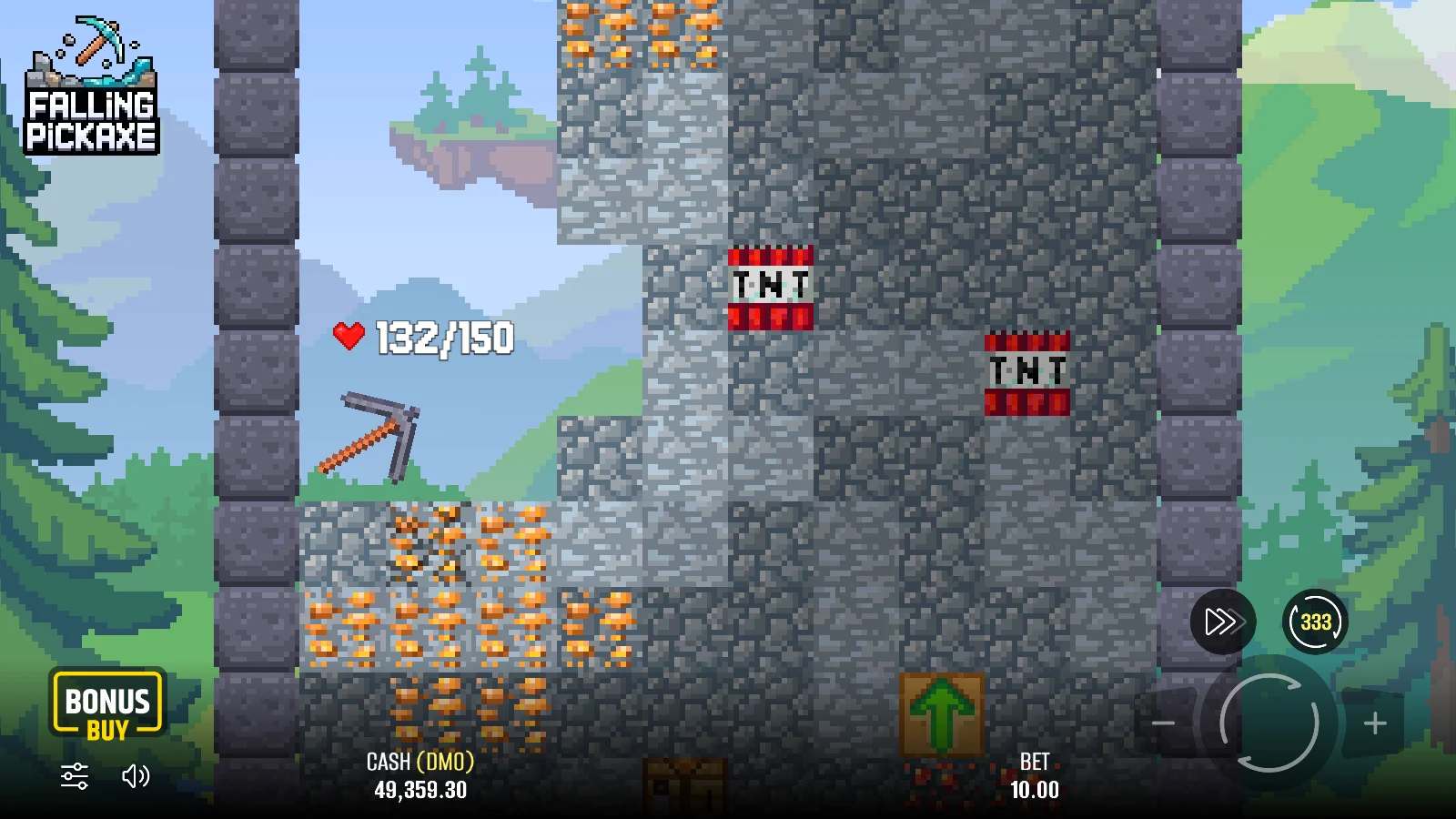
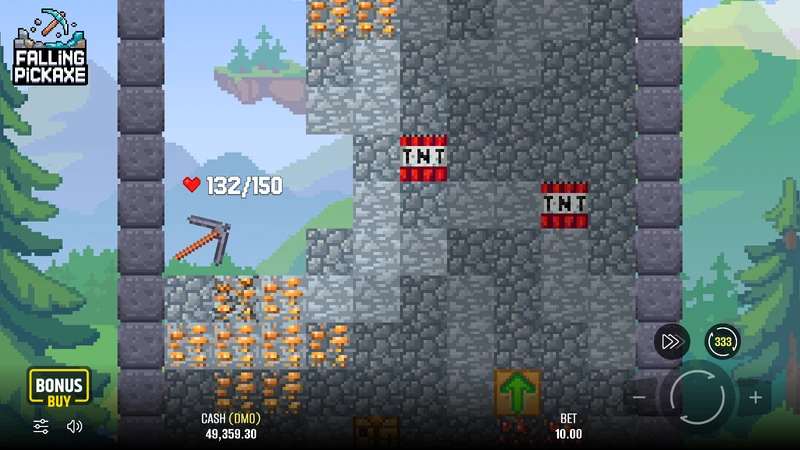
Durability is the budget. Wooden starts at 100 points, Stone at 150, Iron at 200 and Diamond at 400. Every hit costs the pickaxe one point and the block one point, so a tougher block eats more of your round. When the counter hits zero, the round is over and everything collected on the way down is paid at once.
Three blocks change the round rather than pay it. TNT clears a radius. The Upgrade Arrow widens the pickaxe to 1.5 times its size for three seconds, then to 2 times and 2.5 times if you hit another one while the first is still running. The Workbench repairs the tool completely and lifts it one tier, which is the only way a wooden pickaxe ever becomes a diamond one mid-fall.
Where the Money Is in a Round
Ore pays, dirt and stone just block the way. Here is the whole paying side of the game, read off the rules screen: Copper costs 5 hits and pays x0.01 of the bet, Redstone costs 10 and pays x0.05, Gold costs 15 and pays x0.2, Diamond costs 20 and pays x1, and Emerald costs 30 and pays x5.
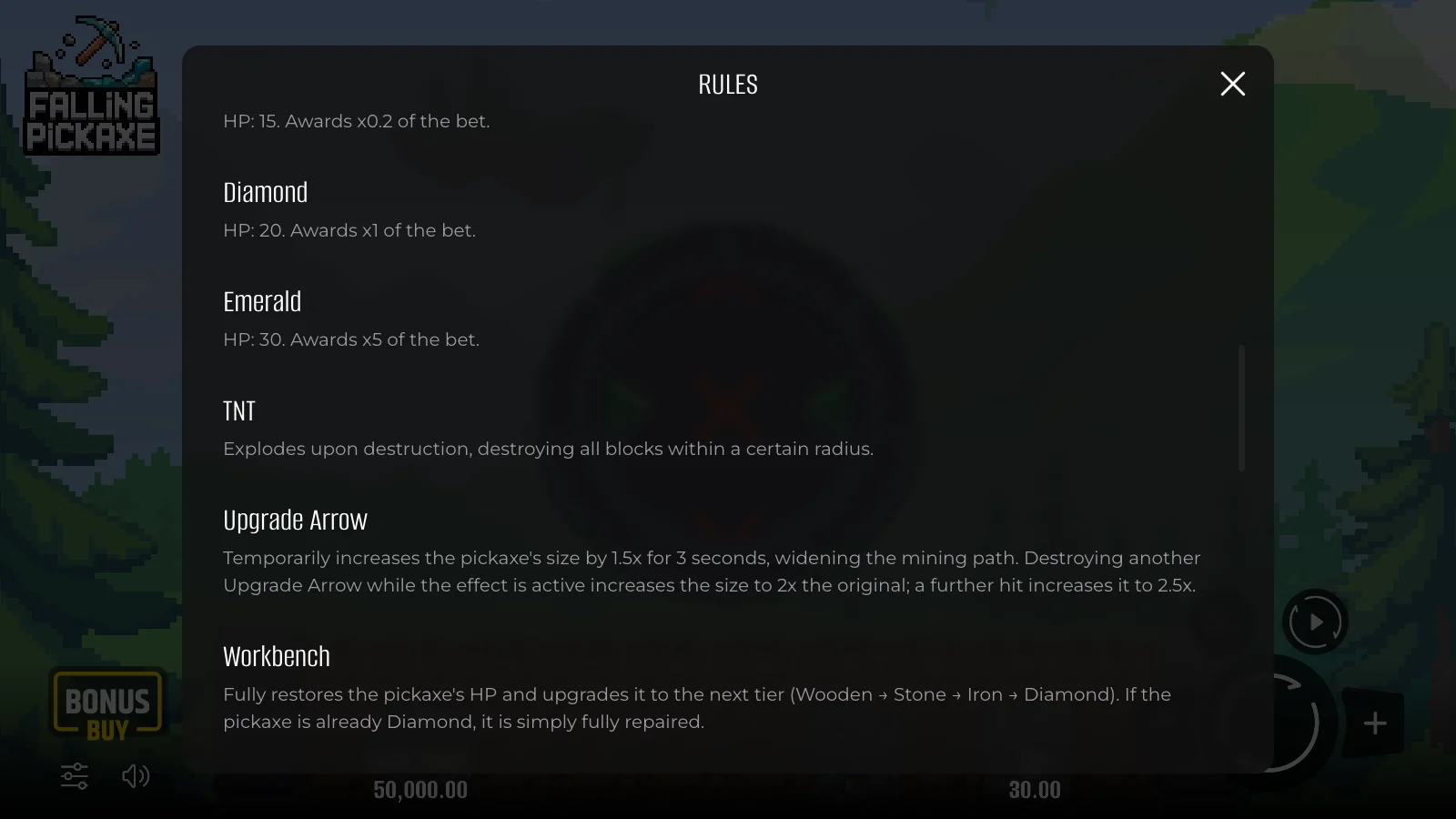
Look at that against the ceiling for a second. The richest single block in the game is worth five stakes, and the published ceiling is 160. A round only reaches anything like that by breaking a great many blocks with one long-lived tool, which is exactly why the Workbench and the Upgrade Arrow matter more than any single ore.
Which Figures Pixmove Publishes
Pixmove states 95% RTP, low volatility and a maximum win on its own game page, and repeats the first two everywhere. The ceiling is where its surfaces split, and both of them are its own.
The game page and the catalogue data behind it both say x160. The press release Pixmove issued on release day, , says x165 in the same list of specifications as the 95%. The game itself leaves it open, naming a ceiling on none of its screens.
We read the client three ways to be sure of that last point. The menu holds one item, RULES. The game's own string table has 38 entries, and a return, a maximum and odds are absent from all of them. A second, shared table belongs to the maker's engine rather than to this title, and it does carry a MAX WIN label that this game never uses. The launch reply from the game server carries neither a return for the base game nor a ceiling.
One line in that reply is worth pulling out, because it is the only return figure anywhere inside the running product. The server sends a short list of the four bonus-buy doors, and each entry carries its price multiplier and the text 95%. The client keeps it off screen entirely. So the figure exists in the product, travels to your browser, and stops one layer short of the screen.
The Eighth Round Rule
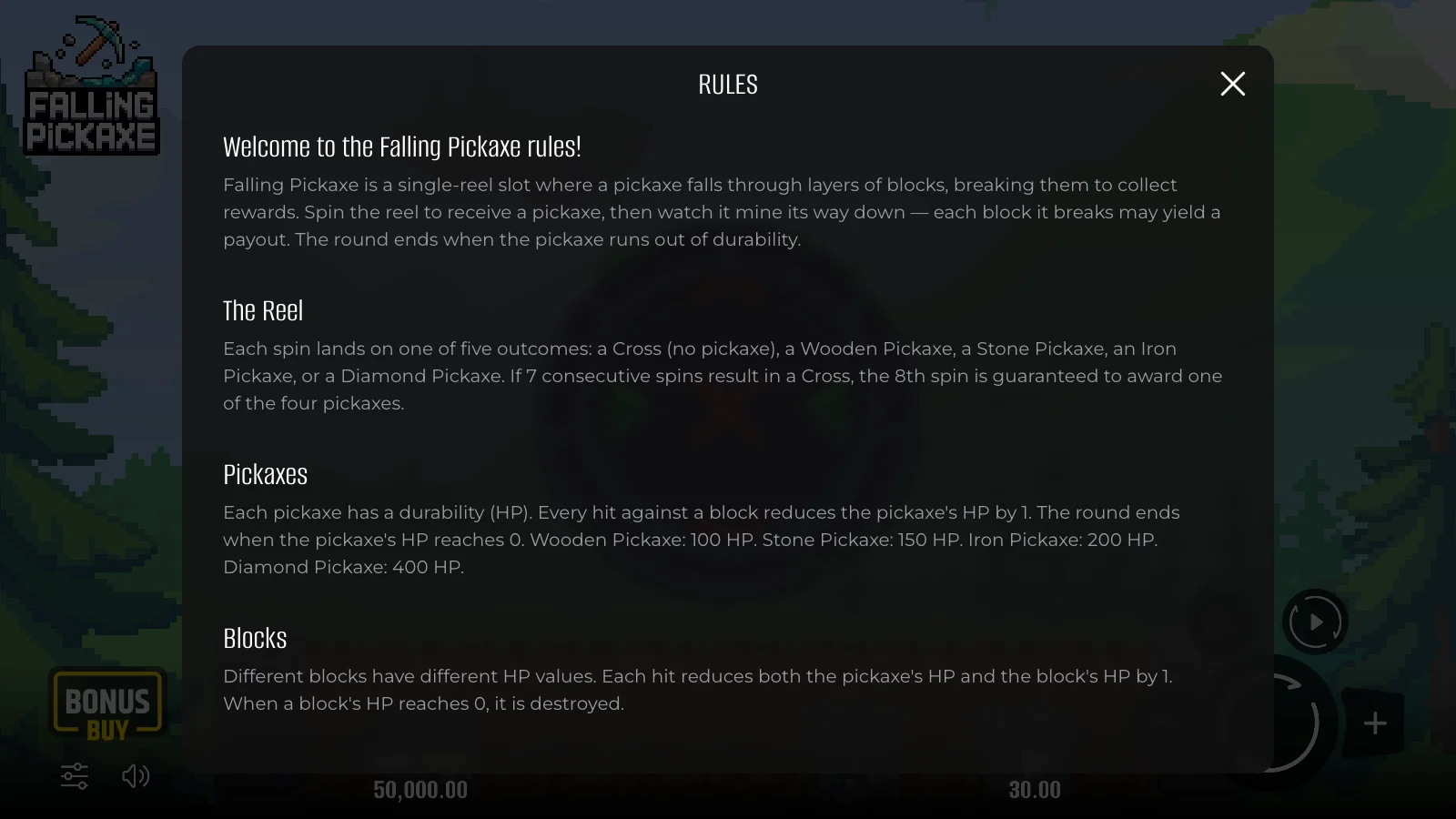
The rules screen makes a promise most games would not: "If 7 consecutive spins result in a Cross, the 8th spin is guaranteed to award one of the four pickaxes." We watched the counter that enforces it, and it does not count what the sentence says it counts.
The server keeps a value it calls lossStreak. Across our 259 logged rounds it ran from 0 to 7 and stopped there every time. It went up after rounds that paid nothing even when a pickaxe had been handed out, which means it counts rounds without a payout rather than spins without a pickaxe. Twelve times it reached seven, and all twelve times the next round paid.
So the game gives slightly more than it promises, though it describes the thing inaccurately, and there is a catch nobody prints. The server keeps that counter one per stake step, and there are fifteen of them. Ours sat at the 10.00 step all session, and the other fourteen stayed at zero the whole time. Change your stake and you start again.
There is a second text worth holding beside this one. The client also loads a shared string table, written for the maker's engine rather than for this game, and it contains the line "The reels are spun with a fair and equal chance for each stop position by a random number generator". That sentence sits in the same file as labels for paylines, scatters and free spins, none of which this game has, and the rules screen a player actually reads says nothing about randomness at all.
The Licence Behind the Game
The licence behind the game is an Anjouan B2B permit, ALSI-202410066-FI2, and it is the one claim on this page that a reader can confirm in a minute. Pixmove puts an Anjouan seal in its own footer, the seal leads to a validator, and the validator answers: Pixmove Ltd., licence valid, registered website pixmove.com. The authority's downloadable register files that company under ALSI-202410066-FI2, issued on , against the same domain. The maker itself leaves the number to the register.
Two things sit beside that, and both are checkable. The register gives the licence an expiry of , which was three days after we read it on . A licence can be renewed, and this is a date rather than an accusation. The other thing is the entity. The footer of pixmove.com, a line below the seal itself, reads "Pixmove BV Heelsumstraat 51 E-commerce Park Vredenberg Curaçao", while the validator and the register both call it Pixmove Ltd. with an address on Anjouan.
What the licence actually buys the player is set out by the authority itself. Its validator states that the Anjouan Gaming Board "do not hear, consider, or mediate player-level disputes (such as payouts, bonuses, account management etc)". Our fuller reading of that register sits on the licence page.
Where the Falling Pickaxe Name Came From
Falling Pickaxe is a name Pixmove borrowed, and the game is the newest of five things to carry it. An open-source project of the same name has been on GitHub since , under the GPL-3.0 licence, with 72 stars and 44 forks. It is a chat-controlled livestream game in which viewers type commands such as tnt, fast and diamond to change a falling pickaxe, and it is free. Its own readme calls it "inspired from YouTube shorts livestreams" and never mentions Minecraft; the channels that stream it supply that framing.
Pixmove is open about the inspiration. Its press release sells "the viral appeal of streamer mechanics" and a "legendary pixel-art style, instantly recognisable to anyone who spent their youth building dirt houses and digging for diamonds". Four other things now share the name as well, and only one of the five takes a stake. That is its own page.
Who Should Skip This Game
We do not recommend Falling Pickaxe to anyone who wants to check the maths of what they are playing, because the one number that describes the long run is not in the game. The mechanics you can check on its own rules screen; the return you can only read on a marketing page, and the two marketing surfaces disagree.
It reads differently if you have come for the thing itself. The animation is good, the demo is genuinely free, and the smallest stake is the smallest number on the ladder. That is a fair trade for entertainment, and a poor one for anybody treating the ceiling as a plan.
Which Surface Prints Which Figure
| Surface | Return | Ceiling | Volatility |
|---|---|---|---|
| Pixmove game page | 95% | x160 | Low |
| Pixmove catalogue data | 95 | 160 | low |
| Pixmove press release, | 95% | x165 | Low |
| The game's own rules screen | none | none | none |
| The game server's launch reply | 95% on each of the four buys | none | none |
Our Falling Pickaxe Verdict and Rating
Key Terms Used on This Page
- Durability
- The hit budget of a pickaxe, from 100 points on the Wooden one to 400 on the Diamond, spent one point per block struck.
- Cross
- The reel outcome that hands over no pickaxe at all, and one of the five the rules screen names.
- lossStreak
- The counter the game server keeps for rounds that paid nothing, running 0 to 7 and held one per stake step.
- Instant-win game
- The category Pixmove files this title under, meaning a single round resolves on its own without reels of symbols combining.
Not sure yet? Learn the round with play money before any deposit.
Try the free demo first →This site takes no deposits and runs no identity checks; both stay off it entirely.
Related Reading on This Game
More on this game, from the same section first:
 Guides
Free Demo
50,000.00 in play money, no signup
 Reference
The 95% Figure
RTP 95%, printed nowhere in the game
 Guides
How a Round Works
Five outcomes, four pickaxes, 100 to 400 HP
 Guides
The Four Buys
Four buys from x2.99 to x10.50 stake
 Reference
The Ceiling Dispute
x160 on the page, x165 in the release
 Guides
The CNC Check
28 casinos and 3 bingos on the CNC list
 Reference
Licence Questions
Licence ALSI-202410066-FI2, read 14 Oct 2026
What Else Do Readers Ask?
The questions below are the ones our own session raised, and the answers come from the rules screen, the game server replies we logged and the licence register, never from a catalogue listing.
Does Falling Pickaxe show its RTP anywhere in the game?
No, nothing in the client prints a return figure. The 95% comes from the maker's game page, its catalogue data and its press release.
Is the maximum win x160 or x165?
Pixmove publishes both. Its game page and catalogue data say x160, and its own press release of says x165.
Is the eighth spin really guaranteed?
Yes, in our 259 logged rounds. The streak counter reached seven twelve times, and the next round paid on all twelve occasions.
Does changing my stake reset that streak?
Yes. The server keeps a separate counter for each of the fifteen stake steps, so progress stays behind when you switch.
Is Pixmove licensed?
Yes, as a B2B supplier on Anjouan, licence ALSI-202410066-FI2, issued and listed against Pixmove Ltd.
Can I play Falling Pickaxe for free?
Yes. The maker's demo opens from its game page with 50,000.00 in play money, and asks for neither an account nor an age check.
How do we test a game like this?
We play the maker's demo, log the game server's replies round by round, read the rules screen in full and check the supplier in a public register.