

Falling Pickaxe Bonus Buy: Four Doors, Four Prices
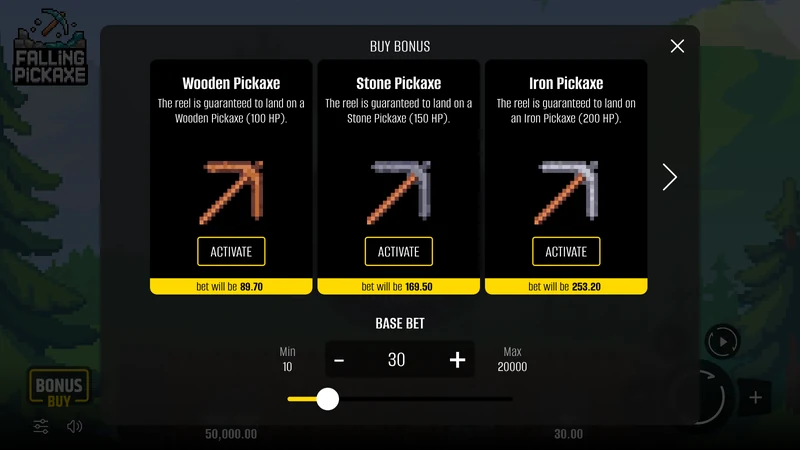
In short: The Falling Pickaxe bonus buy has four doors, and each one guarantees a pickaxe tier instead of leaving it to the reel. At a 30.00 base stake they cost 89.70, 169.50, 253.20 and 315.00.
Every door here buys the same thing: durability. Every one is sold on durability rather than on a better chance of hitting ore, and the return stays off every screen.
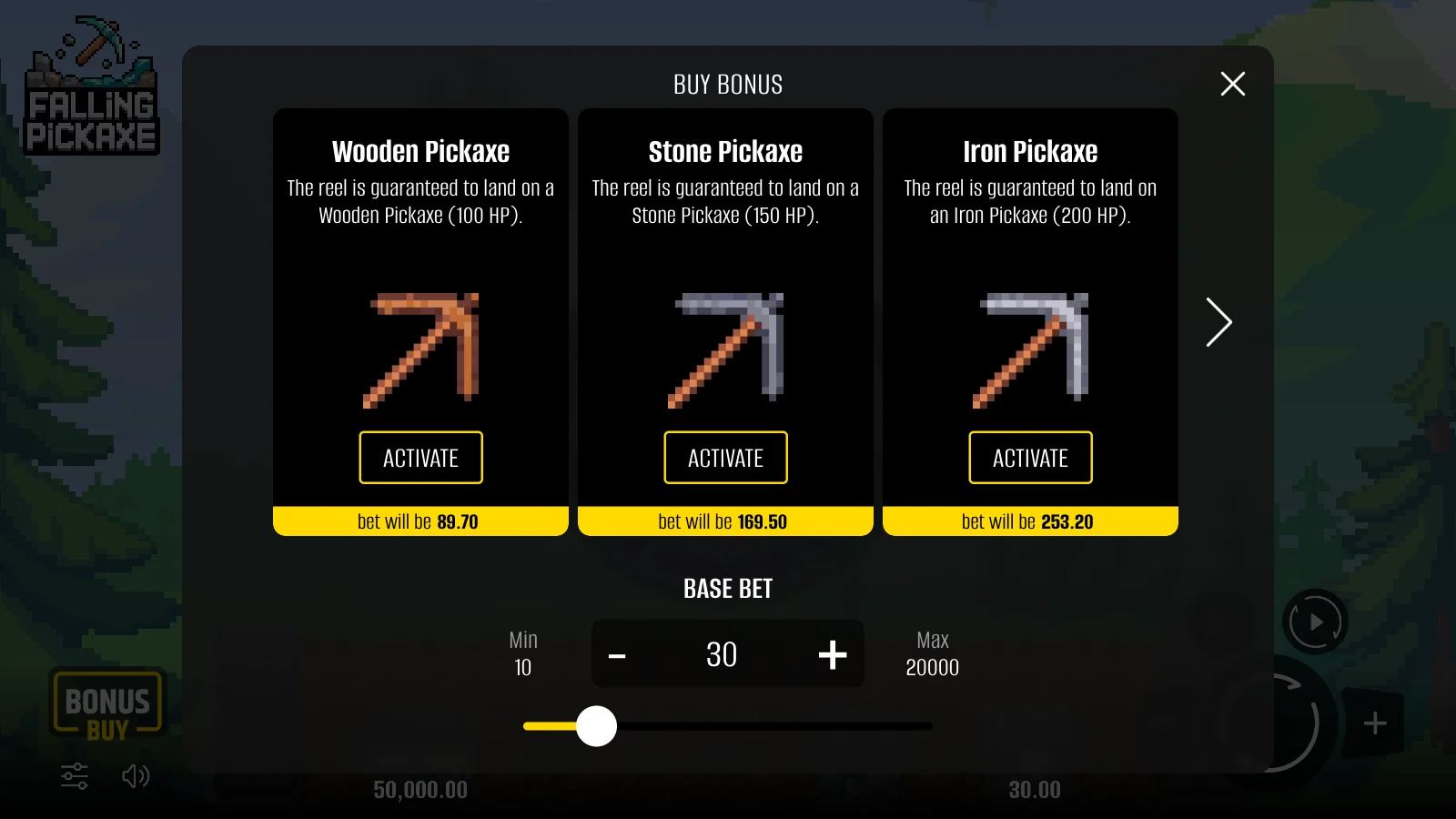
Table of contents
- Price Each Door per Point
- Think Twice About Iron
- A Door Buys a Tier, Not a Seam
- Prices Follow Your Stake
- Open the Screen Even if You Never Buy
- What a Bonus Buy Actually Buys
- Bonus Buy Price per Durability Point
- Why Depth Changes the Sum
- Reading the Buy Screen in the Demo
- What the Client Never Shows You
- What We Would Not Buy
- Key Terms Used on This Page
- What Else Do Readers Ask
Price Each Door per Point
At a 30.00 base stake, Wooden works out at 0.90 per durability point, Stone at 1.13, Iron at 1.27 and Diamond at 0.79.
Think Twice About Iron
Iron costs more per point than anything else on the screen, and the tier above it is tougher and cheaper by that measure.
A Door Buys a Tier, Not a Seam
Each card promises one thing only: that the reel lands on a named pickaxe. Nothing on the screen says anything about the blocks waiting below it.
Prices Follow Your Stake
Every door is a fixed multiple: 2.99, 5.65, 8.44 and 10.50 times the base stake you set.
Open the Screen Even if You Never Buy
Open the buy screen once for the limits alone: it is the only place in the client that prints both ends of the stake range, Min 10 and Max 20000.
What a Bonus Buy Actually Buys
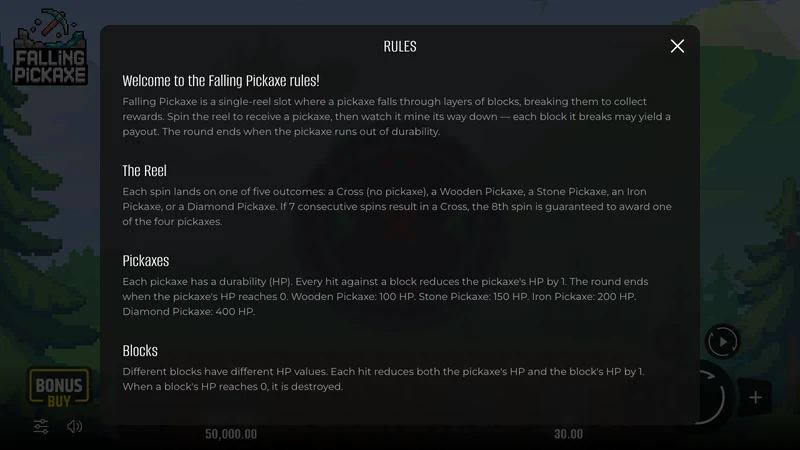
A bonus buy buys durability, and nothing else. Each card states it plainly. The reel is guaranteed to land on a Wooden Pickaxe with 100 points, a Stone with 150, an Iron with 200 or a Diamond with 400.
| Door | Guaranteed pickaxe | On-screen price at a 30.00 stake | Times the stake | Price per point of durability |
|---|---|---|---|---|
| Wooden | 100 HP | 89.70 | x2.99 | 0.897 |
| Stone | 150 HP | 169.50 | x5.65 | 1.130 |
| Iron | 200 HP | 253.20 | x8.44 | 1.266 — the dearest |
| Diamond | 400 HP | 315.00 | x10.50 | 0.7875 — the cheapest |
Read on ; the maker can change a screen without saying so.
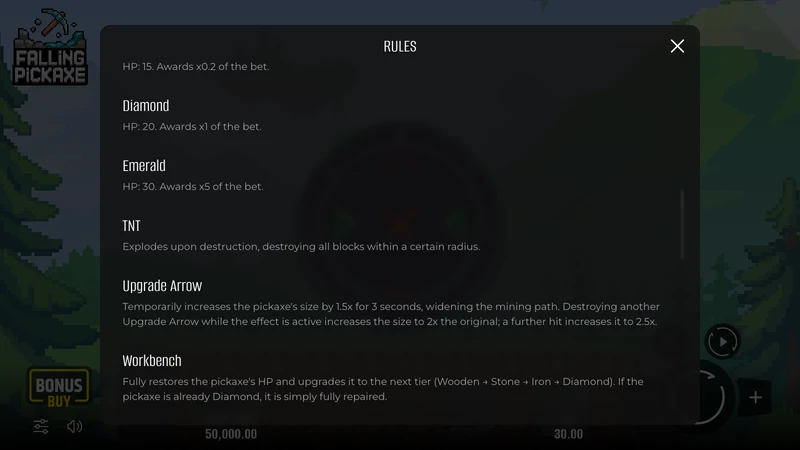
That matters because the reel's fifth outcome is a Cross, which hands you nothing at all. Buying removes that outcome from the round. What the card promises is the tier and its durability, and it says nothing at all about the blocks waiting below.
Bonus Buy Price per Durability Point
That price is arithmetic you have to do yourself, and the client never does it for you. At a 30.00 base stake, the Wooden door costs 89.70 for 100 points, which is 0.90 per point. Stone costs 169.50 for 150, or 1.13. Iron costs 253.20 for 200, or 1.27. Diamond costs 315.00 for 400, or 0.79.
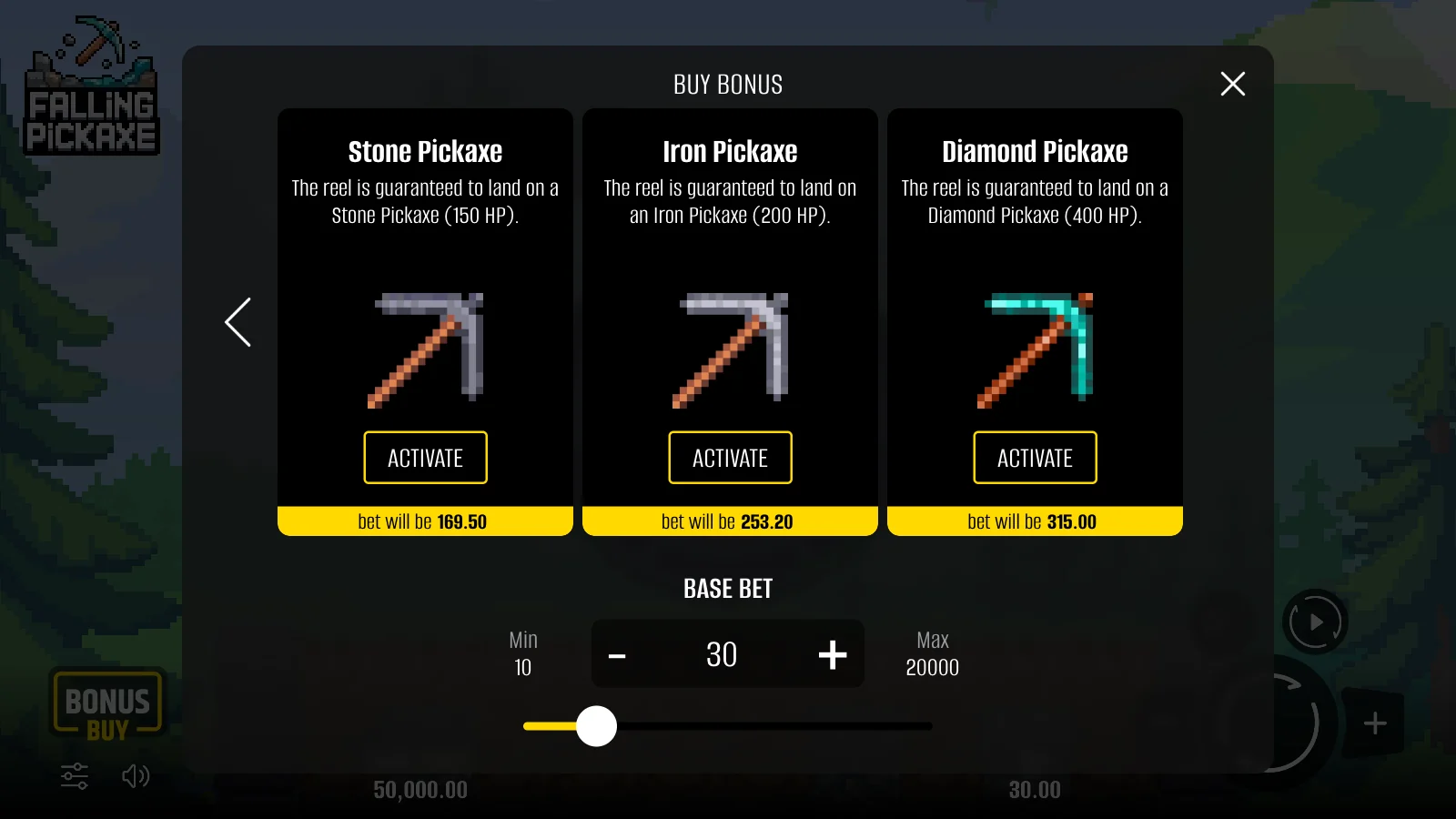
So the ladder runs backwards. The cheapest hits on the screen are in the most expensive door, and the worst value sits in the middle at Iron, which costs 61% more per point than Diamond does.
Why Depth Changes the Sum
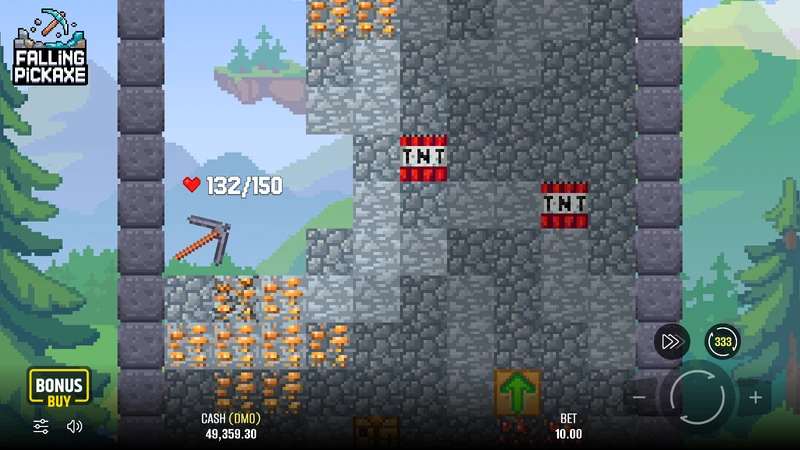
Depth changes the sum because the shaft gets richer the deeper it goes, so a longer round is a richer one as well. Our recorded session showed thin dirt and stone near the top and dense redstone and gold seams further down, which is also what the maker's own description promises.
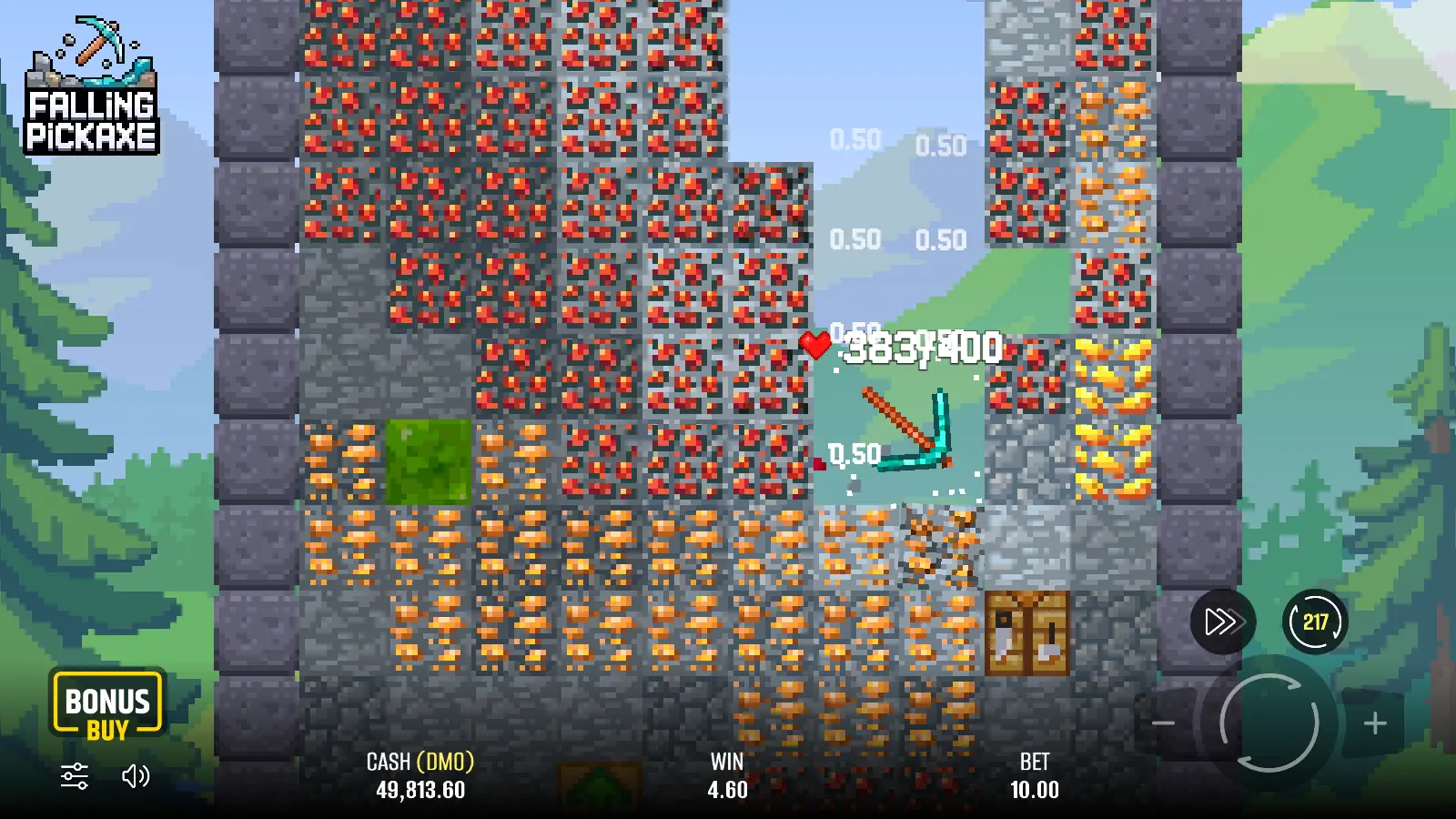
That is the real argument for the Diamond door. Four hundred points is enough to reach the dense layers with hits to spare, and a Workbench down there repairs the tool outright rather than lifting it one rung. Still, none of this is a return figure, and we would not dress it up as one.
Reading the Buy Screen in the Demo
Read the buy screen in the demo in this order: the four prices, the two stake limits under them, and then what each card promises. It opens in the free demo, which makes it the cheapest screen in the game to study. Open it, set a base stake you would actually use, and write the four numbers down. We priced the doors this way and then played the session at the base stake instead, so nothing on this page is a report of a bought round.
Do that once and the multiples stay with you. The cards always read 2.99, 5.65, 8.44 and 10.50 times whatever the slider says. At a 10.00 stake that is 29.90, 56.50, 84.40 and 105.00, and the game server sends the same four multipliers at launch.
What the Client Never Shows You
Pixmove publishes one return, 95%, on its own pages, and no screen in the game states a return for any door. The figure does exist inside the product. The launch reply from the game server carries a short list of the four doors, each with its price multiplier and the text 95%.
| What the door is sold on | What the screen says | What the server's launch reply adds |
|---|---|---|
| The tier of the pickaxe | Named on every card | The same four multipliers, 2.99, 5.65, 8.44 and 10.50 |
| Its durability in points | Printed in brackets on every card | Nothing further |
| A return for the door | Nothing on any screen | 95% against each of the four |
| The blocks waiting below | Nothing on any card | Nothing in the reply |
So all four doors carry the same stated return as the game itself, and a player learns it from the traffic or nowhere. Read that twice, because it cuts both ways. In return terms the four doors stand level. None is worse either, on the only figure the product carries.
What We Would Not Buy
The one door we would not buy is Iron at 253.20, and we do not recommend it. It is the worst value on the screen by the only measure the screen gives you, and the step up to Diamond costs 61.80 more for twice the durability.
The honest position on all four is the same. Every screen in the client leaves the door returns out. Our own session ran at the base stake rather than through the buy screen, so a measured figure of our own is missing.
Key Terms Used on This Page
- Bonus buy
- The screen that guarantees a pickaxe tier for a fixed multiple of the stake, priced here at 2.99, 5.65, 8.44 and 10.50 times it.
- Durability
- The hit budget a door buys, from 100 points on Wooden to 400 on Diamond.
- Base stake
- The figure every door is priced against, settable from 10.00 to 20,000.00 on the same screen.
Not sure yet? Learn the round with play money before any deposit.
Try the free demo first →This site takes no deposits and runs no identity checks; both stay off it entirely.
Related Reading on This Game
More on this game, from the same section first:
 Guides
Free Demo
50,000.00 in play money, no signup
 Guides
How a Round Works
Five outcomes, four pickaxes, 100 to 400 HP
 Guides
The CNC Check
28 casinos and 3 bingos on the CNC list
 Reviews
500 Rounds Tested
92.0% returned over 500 demo rounds
 Reference
The 95% Figure
RTP 95%, printed nowhere in the game
 Reference
The Ceiling Dispute
x160 on the page, x165 in the release
 Reference
Five Games, One Name
Open-source original dates from 22 March 2025
What Else Do Readers Ask?
These are the questions the buy screen raises and leaves hanging. The prices below are the ones we read off it at a 30.00 base stake on .
How much does the bonus buy cost?
At a 30.00 base stake the four doors cost 89.70, 169.50, 253.20 and 315.00, which are fixed multiples of your stake.
Does the price rise after a losing run?
No. Each door stays a fixed multiple of the base stake, and nothing in the client raises or lowers it between rounds.
Which door did your own session use?
None of them. Our 500 rounds ran at the base stake, so this page prices the doors and leaves their measured return open.
What exactly does a door guarantee?
One thing: that the reel lands on the named pickaxe, with its durability. The cards say nothing about the blocks waiting below.
Can I lose more than the door price?
No. The price shown on the card replaces your stake for that round, so it is the whole of what the round costs you.