Table of contents
RTP, as Pixmove Publishes It
RTP is the share of all stakes a game is modelled to hand back over a very long run. Pixmove publishes 95% for this title in three places: its game page, its catalogue data and its press release. No screen inside the game prints it.
- Game:
- Falling Pickaxe (a Pixmove instant-win game)
- Type:
- Instant game
- RTP as published:
- 95%, printed on the maker's own game page, in its catalogue data and in its press release, and printed on no screen inside the game itself.
- Max win:
- 160 times the bet, which is what the maker's own game page and its catalogue data both print.
Where the RTP Figure Comes From
The RTP figure comes from three places, all of them Pixmove's. The game page for the title states 95%. The catalogue data that page is built from carries the same value as a plain number. And the press release Pixmove issued on release day, , lists "RTP: 95%" among its specifications.
| Surface | Prints 95% | What it prints instead |
|---|---|---|
| The maker's game page | Yes | — |
| The maker's catalogue data | Yes | — |
| The maker's press release | Yes | — |
| The game server's launch reply | Yes, against each of the four bonus-buy doors | — |
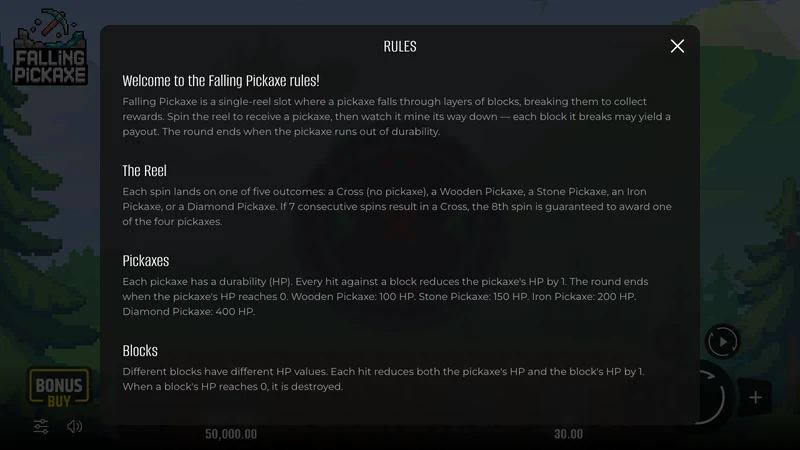
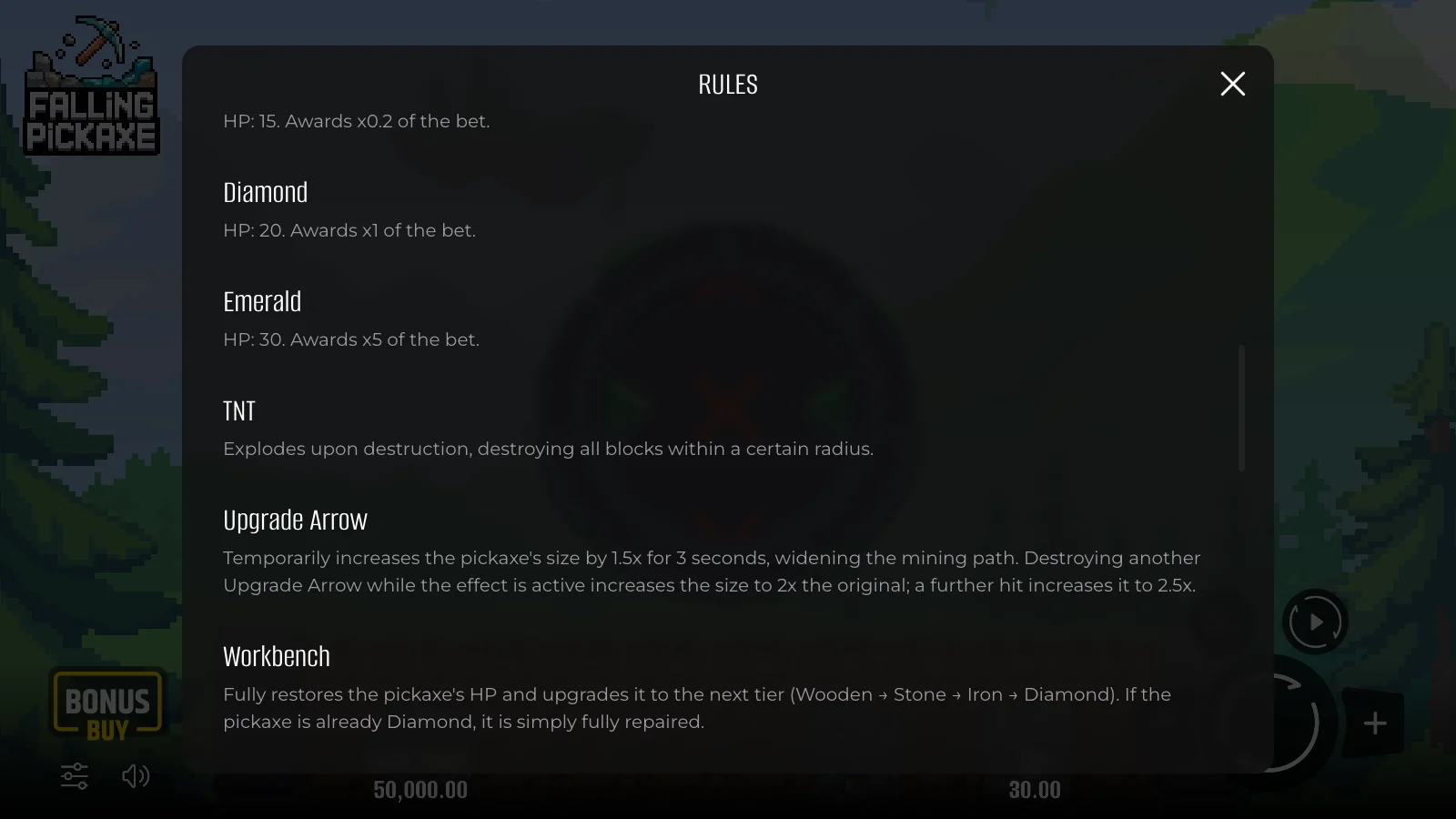
| The rules screen in the client | No | Mechanics, durability and every block payout |
| The game's string table of 38 entries | No | No return, no ceiling, no odds |
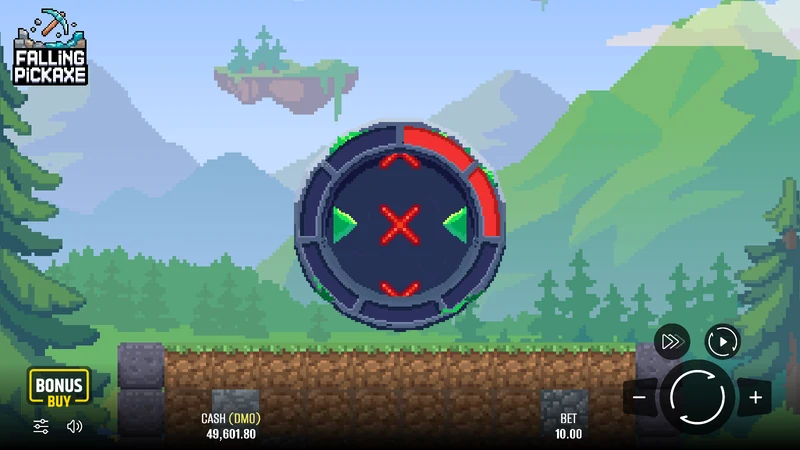
| The client's own interface | No | CASH, BET and WIN, and nothing else |
Read on ; the maker can change a screen without saying so.
That is a consistent figure from one source, which is better than it sounds. On the ceiling, the same maker prints two different values, so the agreement here is worth noting rather than assuming.
What the Game Prints Instead
The game prints nothing at all in place of it, and that is true of every screen a player can open. We looked in three separate places inside the client.
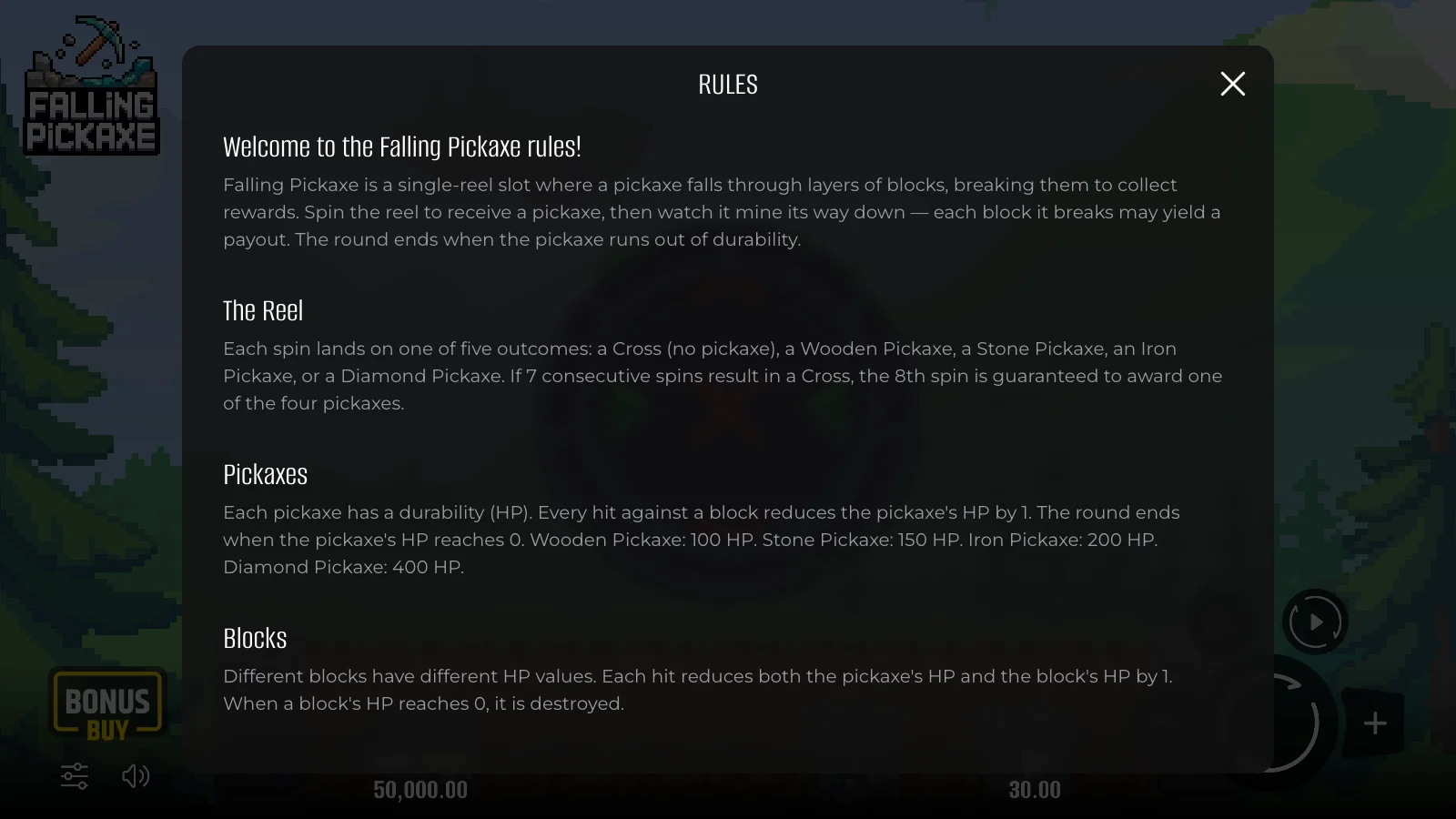
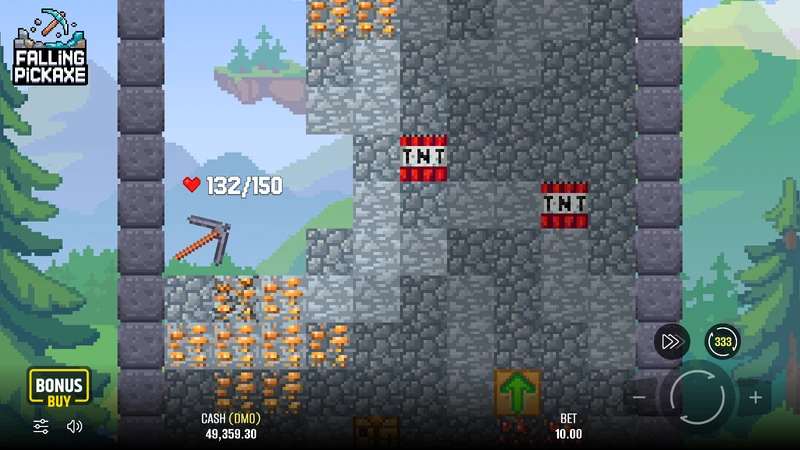
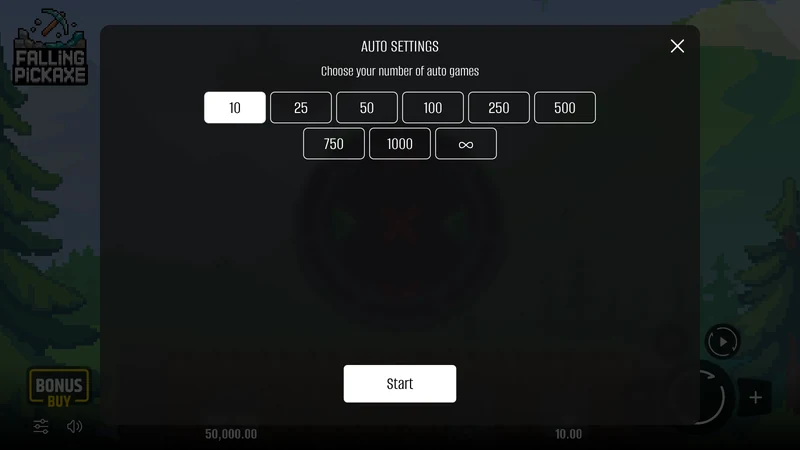
The menu holds one item, RULES, and that screen runs from the reel to the block values to the controls without naming a return. The table of strings written for this game has 38 entries, and the words return, RTP, maximum and odds are absent from every one of them. A second table ships with it, 97 entries belonging to the maker's engine rather than to this title, and that one does carry RTP, Max and a MAX WIN label — none of which this game ever draws.
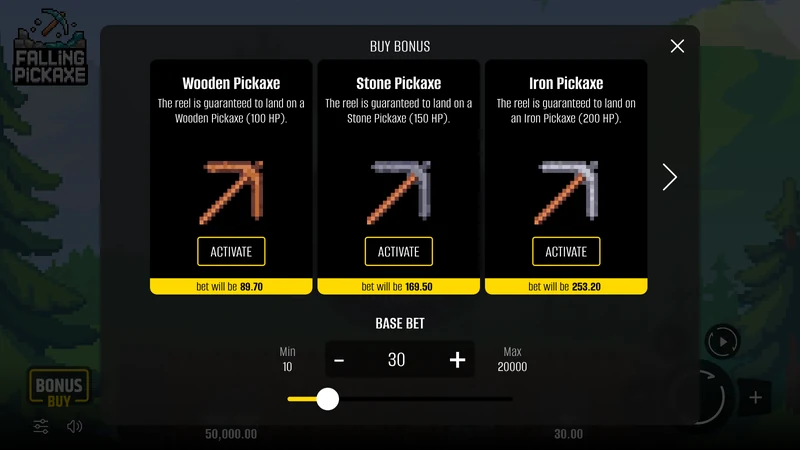
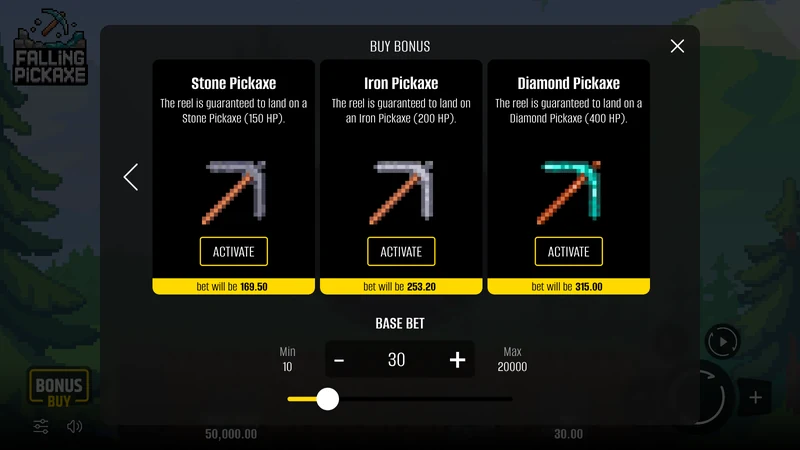
The third place is the interesting one. The third place is the reply the game server sends at launch, which we decrypted and logged. It carries neither a return for the base game nor a ceiling. It does carry a short list of the four bonus-buy doors, with the text 95% against every one of them. That figure is inside the product and arrives in the browser, where it stays off screen.
So the player's position is simple. You can read the mechanics in full inside the game. For the one number that describes the long run, you either leave the game or read the traffic.
Why One Site Prints 96%
One site prints 96% because a single copying step moved the number, and the same step moved two others on the same page. Four English sites about this game were live when we checked on , and exactly one of them prints a return that is absent from everything the maker publishes.
| Copy site about this game | Return it prints | Ceiling it prints | Volatility it prints | Release date it prints |
|---|---|---|---|---|
| fallingpickaxe.games | 96%, eight times over | x21,100 | Medium | |
| falling-pickaxe.com | 95% | x160 | Low | |
| fallingpickaxegame.com | 95% | x160 | Low | June 2026, no day given |
| thefallingpickaxe.com | 95% | x160 | Low | |
| What the maker publishes | 95% | x160 and x165 | Low |
One site aimed at India prints 96% eight times in its visible text. It also calls the volatility "Medium (average, as official figure is not published)". Pixmove publishes the volatility as Low, on all three of its surfaces. The same site prints a ceiling of "x21,100", which appears nowhere in anything the maker has published. The other three print 95% correctly. Then, on the same page, all three call roughly 96% an industry average. That is where the half-remembered number comes from.
We do not recommend taking a return figure from an aggregator for any game. This one shows why: the drift happens in a single step of copying, and it runs in both directions. The same site that raises the return to 96% also moves the release date earlier, to 8 June, and turns a published Low volatility into Medium.
Reading an RTP of 95% Honestly
A 95% return means the model gives back 95 units for every 100 staked across a run far longer than anyone plays. The other 5% is the house edge, and it applies to every stake equally.
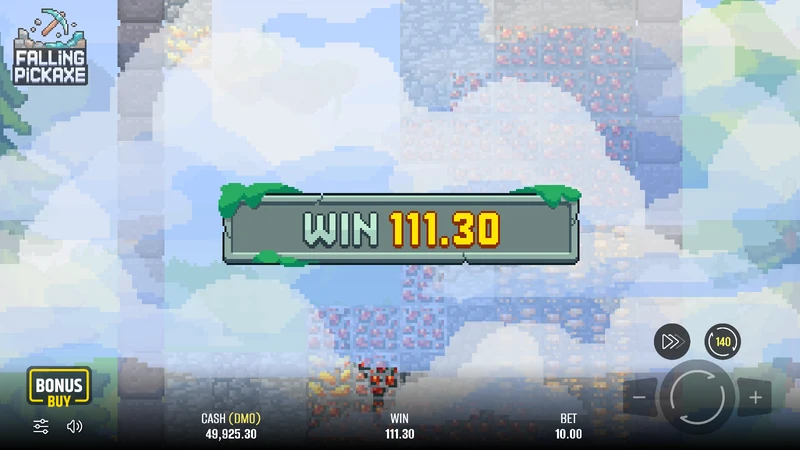
Our own session is a good illustration of why a short run proves nothing either way. We played 500 rounds at a 10.00 stake and got 92.0% back. That is three percentage points below the published figure, and far too short a run to bear on it. One round of ours paid 43.16 times the stake, and a single round like that moves the whole session total.
The honest summary is short. Nobody outside can verify the 95%, and that includes us. The maker makes that harder than it needs to be by keeping the figure off every screen.